
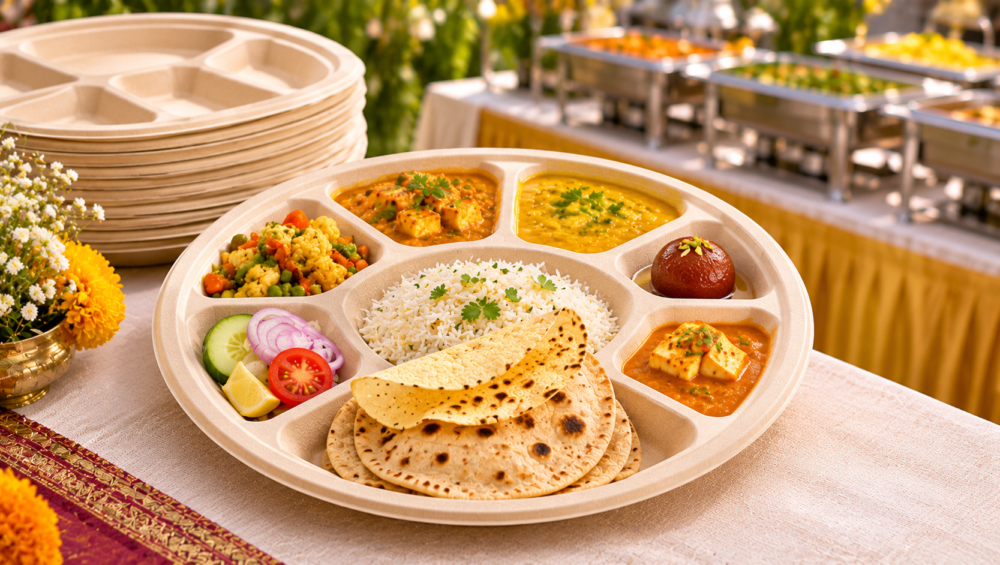
A catering plate needs to do more than hold food. It should accommodate the right portions, keep dishes organised and remain comfortable to carry throughout the meal. When serving rice, roti, dal, vegetables and accompaniments together, the plate’s layout matters as much as its size.
Disposable thali plates offer a practical way to serve multiple dishes on one plate. For caterers, restaurants and event organisers, choosing the right option starts with understanding the menu, serving conditions and order requirements.
This guide explains what to check when selecting disposable plates with compartments for Indian meals and bulk catering orders.
Start With Your Menu and Portion Sizes
Before comparing plates, list the dishes you plan to serve and estimate their portions. A simple lunch with rice, a vegetable dish and an accompaniment needs a different layout from a meal with several curries, breads and dessert.
Consider:
- Main dishes: Allow enough space for rice, biryani, pulao or roti.
- Side dishes: Match smaller compartments to the portions of vegetables, chutney or salad.
- Gravy-based dishes: Check compartment depth and leave space below the rim.
- Additional items: Decide whether dal, raita or dessert would be better served in a separate bowl.
Avoid choosing a plate by diameter alone. Two plates of the same overall size can have very different usable space because of their compartment layout.
A useful first step is to arrange an actual serving on a sample plate. This shows whether the meal fits comfortably without overcrowding.
Choose the Right Number of Compartments
Disposable plates with compartments help organise food and reduce contact between dishes during normal serving. However, the number of sections should match your menu.
Three-Compartment Plates
A three-compartment plate can suit a main dish with two smaller accompaniments. Depending on the layout, the larger section may accommodate rice or bread, while the other sections hold vegetables, salad or a side dish.
This can be a practical starting point for simpler catering menus and portion-controlled meals.
Four-Compartment Plates
A four-compartment plate provides an additional section for menus with more variety. It may help when serving a main dish alongside several sides without using an extra plate.
More compartments do not automatically mean more capacity. Check the dimensions and depth of each section, particularly if your menu includes generous rice portions or larger breads.
| Meal Requirement | What to Look For |
|---|---|
| Main dish with two accompaniments | Three compartments with a suitably sized main section |
| Meal with several separate sides | Four compartments with sufficient space for each portion |
| Large rice or biryani serving | A spacious main compartment and a stable base |
| Dal, raita or other liquid dishes | Suitable depth, tested performance or a separate bowl |
| Guests carrying plates from a buffet | Comfortable rim, rigidity and balanced food placement |
Ecodelicious offers three- and four-compartment options within its sugarcane bagasse plates collection. Compare the available layouts against your planned menu before selecting a product.
Assess Performance With the Food You Actually Serve
Indian catering menus can include hot rice, oily vegetables, gravies and moist accompaniments. Plate performance should therefore be assessed under realistic serving conditions.
Ask your supplier for the product’s intended uses and any relevant temperature or food-contact information. Avoid assuming that every disposable plate performs the same way because it uses a similar material.
When testing a sample:
- Serve the food at its usual serving temperature.
- Add the portions guests would normally receive.
- Leave the meal on the plate for the expected eating period.
- Check the base and compartments for softening, seepage or distortion.
- Carry the loaded plate as a guest would during service.
Compartment dividers help separate food, but they do not create sealed sections. Overfilled gravy can still spill into adjacent compartments.
For takeaway orders, also check the packaging arrangement. An open thali plate should not be treated as a sealed delivery container.
Understand What Bagasse Plates Offer
Bagasse is the fibrous material left after juice is extracted from sugarcane. It can be processed into moulded tableware, including plain and compartment plates.
For businesses considering fibre-based disposable thali plates, the important questions concern the finished product: its construction, suitability for the menu and supporting documentation.
Ask the supplier about:
- Material composition, including any coatings or additives.
- Food-contact documentation relevant to the product.
- Recommended conditions for hot, wet or oily foods.
- Any verified microwave or storage limitations.
- Compostability certification and the disposal conditions it covers.
Compostability claims should be read alongside the relevant conditions. A product intended for commercial composting should not automatically be described as suitable for home composting. Check whether an appropriate collection and processing route is available at your venue.
Match the Plate to Your Catering Setup
The way meals are served affects which plate will work best.
For seated service, staff may carry plates to tables or assemble meals before serving. At a buffet, guests may hold a plate while adding food and moving through a queue. Outdoor events may involve longer carrying distances and fewer dining tables.
Test the practical details before committing to a bulk order:
- Can staff separate stacked plates easily?
- Does the plate fit the serving counter and storage area?
- Is it comfortable to hold when fully loaded?
- Can guests reach each compartment without crowding the food?
- Does the layout support consistent portions?
These checks help identify problems that are difficult to judge from product photographs alone.
Calculate Quantities Using the Actual Case Packing
Start with the number of meals being served, then account for staff meals, additional guests and any separate service sessions. Choose a contingency quantity based on the event’s needs rather than applying the same allowance to every order.
Next, confirm how many plates are supplied per case.
For example, if you need 1,100 plates and the selected product contains 500 pieces per case, ordering whole cases would require three cases, providing 1,500 plates. This is an illustration; packing quantities must be checked for the specific product.
For recurring catering orders, also consider storage space and how quickly remaining stock will be used.
Compare the Full Cost of a Bulk Order
The lowest price per plate does not always produce the most suitable order. Compare quotations for equivalent sizes, compartment layouts, packing quantities and delivery terms.
Confirm:
- Price per piece and per case.
- Minimum order quantity.
- Applicable taxes and freight.
- Product availability and expected dispatch timing.
- Sample availability.
- Arrangements for reporting damaged or incorrect deliveries.
Ask whether the quotation includes delivery to your location. A clear comparison makes it easier to understand the total cost and avoid ordering an unsuitable plate simply because its unit price appears lower.
Choose Disposable Thali Plates That Fit Your Service
The right disposable thali plate should suit your menu, portions and serving setup. Begin with the food you serve, compare compartment layouts and test samples before placing a larger order.
Explore Ecodelicious’s disposable bagasse plates to review the available options. For bulk enquiries, share your preferred plate size, compartment requirements, quantity and delivery location with the team.
Contact Ecodelicious for a bulk quotation.

Harshil Lakhani is the Founder of Ecodelicious Pulp LLP, a sustainability-focused company dedicated to creating high-quality, biodegradable and compostable tableware from sugarcane bagasse. With a vision to reduce dependence on single-use plastics, he is helping drive the adoption of practical, eco-friendly alternatives for businesses and consumers worldwide.