
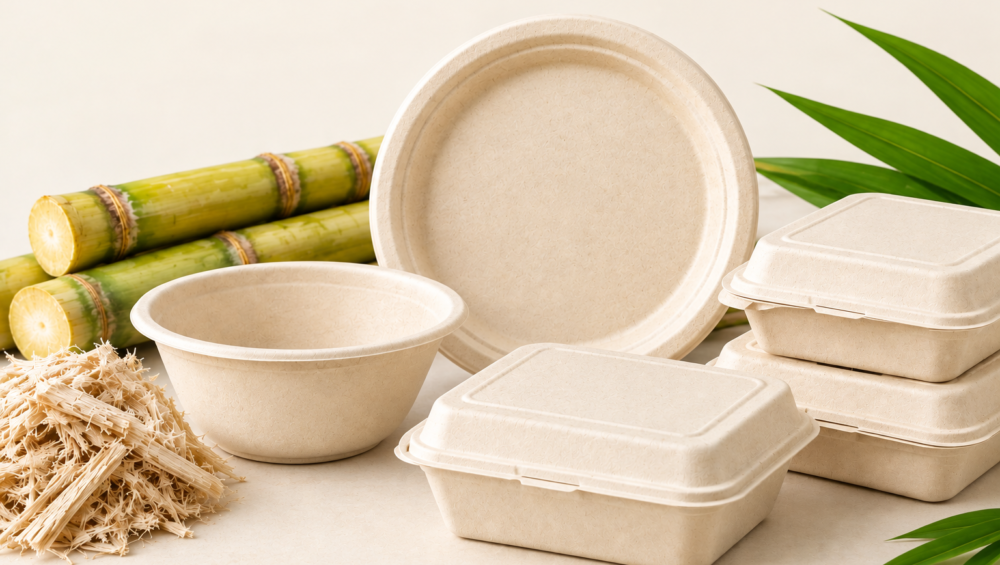
Bagasse tableware is made from the fibrous pulp left over after sugarcane is pressed for juice. It is molded under heat into plates, bowls, trays and clamshells that handle hot, oily food and can be composted in the right facility. It usually costs more than plastic, and it only composts properly where composting infrastructure exists. This guide explains how it works, how it compares with other options, and what to check before you place a bulk order.
What Is Bagasse?
Bagasse is what remains of sugarcane stalks after the juice has been extracted. It looks like pale, dry straw. Sugar mills have traditionally burned much of it as boiler fuel.
The fibre is mostly cellulose, which gives strength, with hemicellulose and lignin making up most of the rest. Lignin acts as a natural binder, which is why molded bagasse can hold its shape without a plastic liner.
Because bagasse is a by-product of sugar production, making tableware from it does not require growing extra crops. India is one of the world’s largest sugarcane producers, so the raw material is available throughout the year. Our factory is in Gujarat, close to that supply.
How Bagasse Tableware Is Made
The process is simpler than most buyers expect.
Preparing the fibre
Raw bagasse is cleaned to remove leftover sugar, soil and other impurities. The fibre is then mixed with water to form a slurry, similar to the pulp used in paper making.
Molding and finishing
The slurry is pressed into a mold under heat and pressure, which forms the shape of a plate, bowl or clamshell and drives out moisture. The pieces are then dried, trimmed and checked for shape, surface finish and strength before packing.
Where manufacturers differ
Some producers add coatings or sizing agents to improve grease resistance. Others rely on the fibre alone. This is one of the main reasons buyers should ask for documentation and not rely on marketing claims.
Bagasse vs Plastic, Paper and PLA
| Property | Bagasse | Plastic (PP/PS) | Coated Paper | PLA |
|---|---|---|---|---|
| Hot, Oily Food | Handles well | Handles well | May soften or leak | Weak at high heat |
| Microwave Use | Generally yes, check the spec sheet | Depends on the resin | Usually not recommended | Usually not suitable |
| Raw Material | Sugarcane residue | Fossil fuel | Wood pulp with a liner | Plant starch |
| End of Life | Compostable in commercial facilities | Persists for a very long time | Liner can block composting | Needs industrial composting |
| Typical Cost | Higher than plastic | Lowest | Moderate | Higher than plastic |
Where bagasse falls short
Bagasse usually costs more per unit than plastic. It is opaque, so customers cannot see the food through the container. It is also not a reusable product, and its compostability depends entirely on where it ends up. In a landfill, it will not break down the way it does in a composting facility.
What to Check Before You Order
Certifications are where many buyers run into problems, so ask for documents and not just claims.
Compostability certification
For North America, look for BPI certification and testing to ASTM D6400. Europe uses EN 13432. Certification applies to specified products, so confirm that the certificate covers the exact item you are buying and not only the supplier’s brand name.
Food-contact compliance
Ask for test reports that show compliance with the food-contact rules of your destination market, such as US FDA regulations or EU food-contact requirements. Be careful with anyone who says a product is “FDA approved.” The FDA does not approve finished tableware products, so what you want is test data.
PFAS
Some molded fibre products use PFAS to resist grease. Several US states now restrict PFAS in food packaging, and regulators elsewhere are paying closer attention. Ask for laboratory results showing the product is PFAS-free, and ask what gives it oil resistance.
Samples
Test samples yourself with your hottest, oiliest and most liquid menu item. This tells you more than any specification sheet.
How Composting Works in Practice
Compostable does not mean the product disappears anywhere. Certified products are tested to break down in commercial composting conditions. Under standards such as ASTM D6400 and EN 13432, disintegration is measured over roughly 12 weeks. Our products break down in about 60 to 90 days under commercial composting conditions.
Home compost piles are cooler and slower, so expect months and not weeks. Tearing items into smaller pieces helps.
Access to commercial composting varies widely by city. Before switching, check whether your local waste hauler accepts certified compostable foodservice items. If not, a bagasse plate still avoids plastic production, but it will not compost.
Where Bagasse Tableware Works Best
Bagasse suits foodservice businesses that serve hot, saucy or oily food, including restaurants, cafés, caterers, food courts and delivery brands. Trays work well for combo meals, thalis and buffets, and clamshells keep takeaway food warm without turning soggy.
Demand is also growing where plastic rules are tightening. India restricts a list of single-use plastic items, and Canada’s single-use plastics regulations cover foodservice ware. Rules change, so always check the current requirements in your own market.
Importing Bagasse Tableware from India
If you are buying in bulk from overseas, settle the practical details before ordering.
Start by confirming that the product is certified for your market and get the certificate. Request a sample, then agree on minimum order quantity, carton size, pallet configuration and lead time. Confirm who handles export paperwork, which shipping terms apply (FOB, CIF and so on), and what customs documents you will need. Finally, check duties and labelling rules in your destination country.
At Ecodelicious Pulp LLP, we manufacture in India and have a presence in Canada, and we export to Canada, the USA, the UK and the Middle East. Buyers can request product specifications, food-contact documentation and compostability certificates before confirming an order. Custom branding and mixed-product containers are available, depending on the products and quantity.
Choosing Bagasse Tableware
Bagasse tableware is a practical choice for hot and oily food, and it avoids fossil-based plastic. It costs more than plastic and only composts where facilities exist. The best way to choose a supplier is to ask for certificates that cover the exact products, ask for PFAS test results, and test samples with your own menu.
To request samples or a bulk quote, contact Ecodelicious Pulp LLP through our website. Tell us your products, quantities and destination country, and we’ll send the matching specifications and documents.
Frequently Asked Questions
Generally yes. Molded bagasse tolerates microwave heating, but limits depend on the product, so check the maximum temperature on the specification sheet. Avoid long heating of very oily food.
Bagasse itself is a plant fibre, but some manufacturers add coatings or sizing agents. Ask any supplier, including us, for written confirmation of what is in the product and what gives it moisture and oil resistance
In commercial composting, certified products are designed to break down within a few months. Ours break down in about 60 to 90 days under those conditions. Home composting is slower and depends on temperature, moisture and how small the pieces are.
Usually not. It tends to cost more per unit, though the gap depends on volume and design. Plastic restrictions and fees in some regions can narrow the difference.
Yes, for normal serving times. For long holding or delivery, test with your own recipe first.
Yes. Custom branding is available depending on the products you choose and your order quantity. Contact us with your requirements.

Harshil Lakhani is the Founder of Ecodelicious Pulp LLP, a sustainability-focused company dedicated to creating high-quality, biodegradable and compostable tableware from sugarcane bagasse. With a vision to reduce dependence on single-use plastics, he is helping drive the adoption of practical, eco-friendly alternatives for businesses and consumers worldwide.