
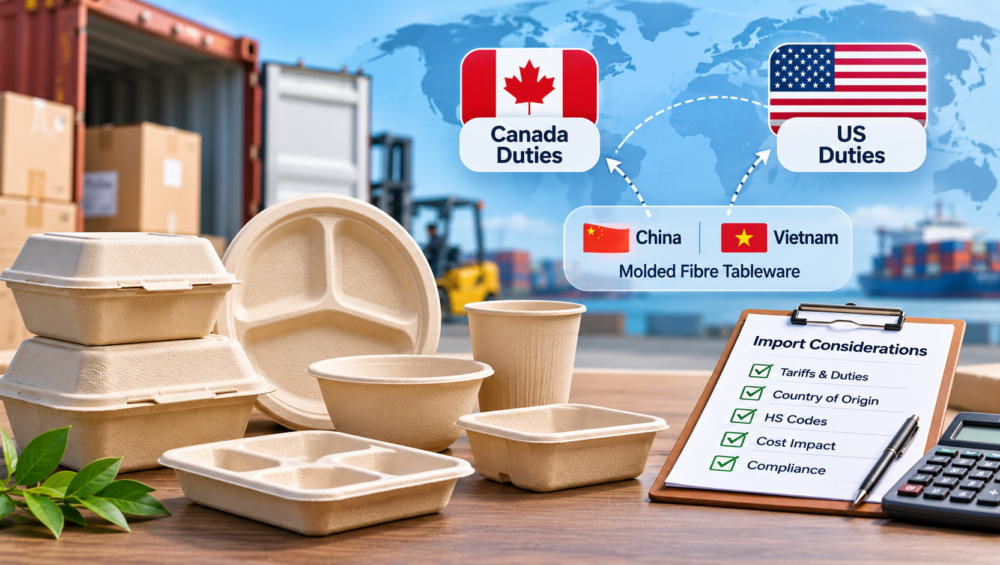
Since June 26, 2026, Canada has collected anti-dumping and countervailing duties on molded fibre plates, platters and bowls made in China. For buyers without an exporter-specific rate, the anti-dumping duty alone is 332.4% of the export price. Across the border, the United States has applied similar duties to molded fibre products from both China and Vietnam since January 27, 2026.
These are not outright bans. Chinese and Vietnamese products can still be imported, but the added duties make many of them uneconomical. For Canadian and US distributors, caterers and foodservice brands, this means one thing: it is time to review where your compostable tableware comes from.
This article explains what each country decided, which products are covered, and what importers can do now.
Canada: duties on Chinese molded fibre tableware
Canada’s measures apply to products from China only. The case began with a complaint from CKF Inc. of Hantsport, Nova Scotia, which the Canada Border Services Agency (CBSA) describes as the only Canadian producer of this tableware. CBSA estimates the Canadian market at about $150 million a year (CBSA).
| Date | Step |
|---|---|
| June 26, 2026 | The Canadian International Trade Tribunal finds injury to Canadian industry, so duties are collected (CITT) |
| May 28, 2026 | CBSA makes final determinations of dumping and subsidizing |
| February 27, 2026 | Provisional duties of 53.7% begin for most exporters (CBSA) |
| December 12, 2025 | Tribunal finds a reasonable indication of injury |
| October 15, 2025 | CBSA opens its investigations |
Current duty rates. For Chinese exporters without their own rate, CBSA applies an anti-dumping duty of 332.4% of the export price. It adds a countervailing duty of 4.83 CNY per kilogram. Six named Chinese exporters have their own, individually assessed rates (CBSA measures in force).
What products are covered. The official definition covers molded fibre plates and platters of any size. It also covers bowls 8 cm or wider with lips up to 8 cm. Fibre source, thickness, colour, coating and finish make no difference. Importers should check the CBSA product definition for items such as clamshell containers and trays before assuming they are excluded.
A related case to watch. On August 17, 2026, CBSA opened a separate investigation into paperboard cups and containers from China (Pulp and Paper Canada). No duties apply in that case yet.
United States: duties on China and Vietnam
The US Department of Commerce issued anti-dumping and countervailing duty orders on molded fibre products from China and Vietnam on January 27, 2026. The orders followed the US International Trade Commission’s December 2025 finding that these imports had materially injured US producers (USITC). They run for five years and can be extended (Packaging Dive via Yahoo Finance).
The US scope is broader than Canada’s. It covers bowls, clamshells, plates, trays and other molded fibre foodservice items. The petitioning coalition reports combined rates as high as 540% for some Chinese producers and 260% for Vietnamese producers. These duties are added on top of any other US tariffs (Pulp & Paper News).
The US orders also cover products made in China or Vietnam and then finished or repacked in a third country. Changing the shipping port does not change where a product was made (Federal Register).
What this means for importers
If you buy plates, bowls or other molded fibre tableware for Canada or the US, the most important question is where it was made. Four steps help protect your margins and avoid surprises at the border:
- Check the country of origin on every SKU. Duties depend on where a product was manufactured, not on the supplier’s head office or the port it ships from.
- Ask for manufacturing proof. A genuine manufacturer can show its factory address, production records and a certificate of origin. Traders who repack goods from other countries cannot.
- Prepare complete customs paperwork. For Canada, CBSA lists the details it expects on import documents for these goods, including the manufacturer, plant location, fibre source and weight per piece.
- Plan a second source. Suppliers in countries not named in either case can reduce the risk of sudden cost increases.
Why buyers are looking to India, and how Ecodelicious can help
India is not named in either the Canadian or the US case. It is also one of the world’s largest sugarcane producers, which gives Indian manufacturers a steady local supply of bagasse fibre.
Ecodelicious Pulp LLP makes sugarcane bagasse tableware at its own facility in Gujarat, India. The products are not repacked from another country. The company also has a presence in Canada, so Canadian buyers can reach a local contact.
What Ecodelicious offers Canadian and US buyers:
- A full foodservice range. It makes plates, bowls, trays, clamshell containers, dona bowls, sipper lids and an unbleached line (product range).
- Documented quality. The company holds BRCGS and ISO 9001:2015 certification, its products are FDA compliant, and they are SGS tested.
- Container-ready specifications. Every product page lists case quantity, weight per piece, carton size and quantity per 40-ft container. This makes landed-cost planning simple.
- Export support. Shipments leave from Mundra or Nhava Sheva on FOB, CIF or CNF terms, with mixed-product containers and private labelling available.
As with any supplier, ask for the specific certificates and test reports for the products you plan to import.
This article is for general information only and is not legal or customs advice. Confirm duty treatment for your products with a licensed customs broker.
Review your tableware sourcing
If the new duties are raising your costs for Chinese or Vietnamese tableware, Ecodelicious can give you a quote for Indian-made bagasse alternatives. Send us your product list and target volumes, and we will reply with specifications, container loading and pricing.
- Export inquiries: export@ecodeliciouspulp.com
- Canada: +1 (587) 973-5802
- India: +91 84699 83739
- Online: Request a quote
Frequently asked questions
countervailing duties to molded fibre plates, platters and bowls from China. Vietnam is not part of Canada’s case. The US duties are the ones that cover both China and Vietnam.
No. As of November 2026, neither Canada’s nor the United States’ measures name India. The product must genuinely be made in India; goods made elsewhere and shipped through India keep their original country of origin.
Canada’s definition names plates, platters and bowls. Check CBSA’s product definition or ask a customs broker about any other item. In the US, clamshells are explicitly covered when they come from China or Vietnam.
The US orders run for five years and can be extended. Canadian findings are also normally reviewed after five years.

Harshil Lakhani is the Founder of Ecodelicious Pulp LLP, a sustainability-focused company dedicated to creating high-quality, biodegradable and compostable tableware from sugarcane bagasse. With a vision to reduce dependence on single-use plastics, he is helping drive the adoption of practical, eco-friendly alternatives for businesses and consumers worldwide.