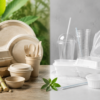

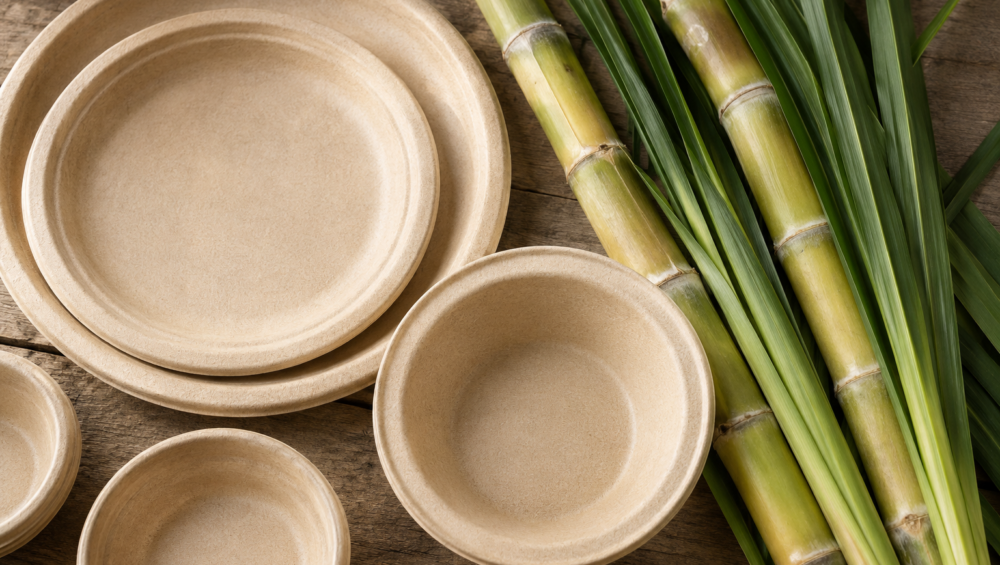
Over 400 million tonnes of plastic waste are generated globally every year – and a significant share of it comes from disposable tableware used for less than 30 minutes. A plate. A bowl. A takeaway box.
The solution isn’t a lab-grown bioplastic or an expensive import. It’s already sitting inside the sugarcane you’ve been juicing for decades.
What Is Sugarcane Bagasse?
Bagasse (pronounced buh-GASS) is the dry, fibrous material left behind after sugarcane stalks are crushed to extract their juice. It makes up roughly 25–30% of the total mass of a sugarcane stalk.
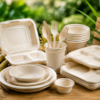
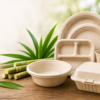
For most of sugar’s history, bagasse was burned as fuel inside sugar mills — a practical but wasteful use of a genuinely useful material. Today, it is increasingly redirected to manufacturers who mould it into plates, bowls, trays, clamshell containers, and more.
India is particularly well-positioned in this space. As one of the world’s largest sugarcane producers — accounting for approximately 20–22% of global production — the country generates enormous volumes of bagasse annually. At Eco Delicious Pulp LLP, we convert that byproduct into food-safe, functional tableware instead of letting it go to waste.
The key point: Bagasse is a byproduct, not a primary crop. No additional land, water, or agricultural inputs are required to produce it.
How Bagasse Tableware Is Made
Understanding the process explains why bagasse performs the way it does.
- Pulping: Raw bagasse from sugar mills is mixed with water to form a thick fibrous slurry.
- Cleaning and refining: The pulp is cleaned to remove impurities and refined to the right fiber consistency. At this stage, manufacturers choose to bleach the pulp (white products) or keep it natural (brown, unbleached products – the cleaner, chemical-free option).
- Moulding under heat and pressure: The refined pulp is pressed into moulds at 150–200°C. Natural fibers interlock and bond under the heat — no adhesives or synthetic binders needed.
- Trimming and quality control: Products are trimmed, inspected, and checked for food safety compliance before packaging.
The process requires significantly less energy than plastics manufacturing, which depends on petrochemical refining.
Key Properties at a Glance
- Heat resistant up to 120°C: safe for hot soups, curries, and microwave reheating
- Refrigerator and freezer safe: suitable for pre-packed meals and cold food delivery
- Oil and water resistant: handles gravies, curries, and fried food comfortably
- Stronger than polystyrene: doesn’t flex or collapse under a full meal
- Free from BPA, PFAS, phthalates, and microplastics
Bagasse vs. The Alternatives
| Property | Bagasse | Plastic | Paper | Bamboo Fiber |
|---|---|---|---|---|
| Source | Agricultural byproduct | Fossil fuels | Wood pulp | Bamboo plant |
| Biodegradable | Yes | No | Yes | Yes |
| Compostable | Yes (60–90 days) | No | Partially | Yes (slower) |
| Microwave Safe | Yes | Often not | Usually not | Sometimes |
| Heat Resistance | High (~120°C) | Low–Medium | Low | Medium |
| Rigidity | High | High | Low | Medium |
| Chemical-Free Option | Yes (unbleached) | No | No | Varies |
Why not paper? Most paper tableware is bleached with chemicals, collapses when wet, and often contains synthetic coatings that compromise compostability. Bagasse outperforms paper on strength, heat resistance, and genuine end-of-life decomposition.
Bagasse vs. bamboo? Both are plant-based and compostable. Bagasse decomposes faster and costs less. Some bamboo products also require binding agents — occasionally including melamine — which raises food-safety questions worth investigating before you buy.
Is Bagasse Tableware Really Compostable?
Yes — but with honest nuance.
Plain bagasse fiber, especially in its unbleached form, can decompose in a home compost system within 60–90 days under the right conditions (moisture, heat, microbial activity). This makes it significantly better than any plastic and better than most paper alternatives.
Two things to watch for
Coatings matter
Some bagasse products use PFAS-based coatings to improve grease resistance. These slow decomposition and may leave residue. Look for products that confirm PFAS-free coatings — reputable suppliers will have documentation.
Bleached vs. unbleached
White bagasse has undergone chemical treatment. It is still compostable, but unbleached (natural brown) bagasse is the purer choice for home composting and leaves no chemical trace in soil.
What to Look for When Buying
Not all bagasse products are equal. Three things to verify before committing to a supplier:
Certifications: Look for FSSAI approval (India), BPI certification (US), or EN 13432 (Europe). Claims without third-party documentation are just marketing.
PFAS-free confirmation: Ask directly. A trustworthy supplier will have paperwork. If they can’t provide it, move on.
Bleached or unbleached option: If composting matters to you, the unbleached range is always the better choice. At Eco Delicious Pulp LLP, we offer both — including a dedicated unbleached line for buyers who want the cleanest possible product.
Conclusion
Eco Delicious Pulp LLP manufactures premium sugarcane disposable plates manufacturer in india and exports sustainable packaging solutions to Canada, the UK, the US, and the Middle East. We help restaurants, caterers, hotels, and food delivery brands replace plastic with durable, compostable alternatives designed for real-world commercial use.
Bagasse tableware delivers performance without compromise – it withstands professional kitchen heat, supports full meals without bending, and naturally decomposes in compost within months. Made from agricultural byproduct that would otherwise go to waste, it transforms sustainability into a practical business decision, not a compromise.
From bulk supply to product samples and custom branding solutions, we support businesses ready to scale their shift away from plastic with packaging that performs as strongly as it protects the planet.

Harshil Lakhani is the Founder of Eco Delicious Pulp LLP, a sustainability-focused company dedicated to creating high-quality, biodegradable and compostable tableware from sugarcane bagasse. With a vision to reduce dependence on single-use plastics, he is helping drive the adoption of practical, eco-friendly alternatives for businesses and consumers worldwide.